For Small Businesses Outgrowing Manual Work
Small business workflow automation, built around how your business actually works.
If your team is copying data between spreadsheets, chasing approvals over email and text, or repeating the same manual tasks every week, a practical system can take a lot of that work off their plate, as long as it fits your actual process, not a generic template. We start with the workflow, then build the system for it.
The Problem
Small businesses don't usually need more software. They need the workflow they already have to stop being held together by hand.
These are the everyday breakdowns that eat time and cause mistakes, not hypothetical ones.
Orders and requests come in through three or four different channels, with no single place to see what's actually pending.
Approvals sit in someone's inbox until they happen to check it, with no record of who signed off on what, or when.
The same customer or order details get typed into a spreadsheet, then a different tool, then an invoice, by hand, every time.
Reporting means someone spends part of every week manually pulling numbers together from separate files.
When the one person who knows the process is out, everyone else is left guessing how it's supposed to work.
The Solution
What changes isn't just the software. It's how much manual work is left over.
Done properly, workflow automation reduces the busywork instead of just documenting it.
One system instead of several disconnected tools
Information lives in one place, entered once, instead of copied by hand between a spreadsheet, a chat thread and an inbox.
Repetitive steps reduced, not just documented
We don't hand over a process diagram and leave the repetitive work in place. Where it makes sense, those steps get built into the system itself.
Visibility without having to ask
Whoever needs to know an order status, an approval, or a number can see it directly, instead of interrupting someone else to find out.
How We Work
A structured process, kept honest about what happens at each stage.
Understanding how the work happens today comes first. Deciding what to build comes after.
-
01
Initial Discovery Call
A short 30-minute conversation to understand your current workflow, the problem you're facing, and whether Noera is a suitable fit. Detailed solution design and consulting are handled separately when needed.
-
02
Written Summary
A short follow-up email, five to eight lines, confirming what we heard and whether it looks like a fit worth exploring further.
-
03
Map the Workflow
If it's a fit, we look closely at how the work actually happens today: the steps, the handoffs, and where it breaks down.
-
04
Shape the System
We define the simplest version worth building, no more than the problem needs, and agree scope and terms before any development starts.
-
05
Build & Test
We build it, test it against how your team actually works, and adjust based on what we find.
-
06
Launch & Support
A proper handover, plus support after launch, so the system keeps working once we're not in every conversation.
Why Noera
A business systems partner, not a dev-for-hire shop.
Noera Tech Solutions is led directly by Radita Pratiwi, who spent eight years in QA leadership and business process reengineering before founding Noera. The work starts with how your business actually operates, not a template it's expected to fit into.
Problem first, technology second
We work out what's actually causing the slowdown before proposing anything to build. The right fix is sometimes smaller than expected.
Direct access
You talk to the person doing the work, from the discovery call through delivery. Nothing gets lost in a handoff between departments.
Built around your workflow, not a fixed package
Nothing here is a tiered product. The scope gets shaped around what your business actually needs, simpler where that's honest.
Remote-first, international by default
We work async across time zones as standard practice, with documentation and handover built into delivery, not treated as an afterthought.
Real Projects, Delivered
Systems built and actually in use, not concepts.
One is a system built for a client, the other is Noera's own product. No invented numbers, just what each one actually does.
Live in production
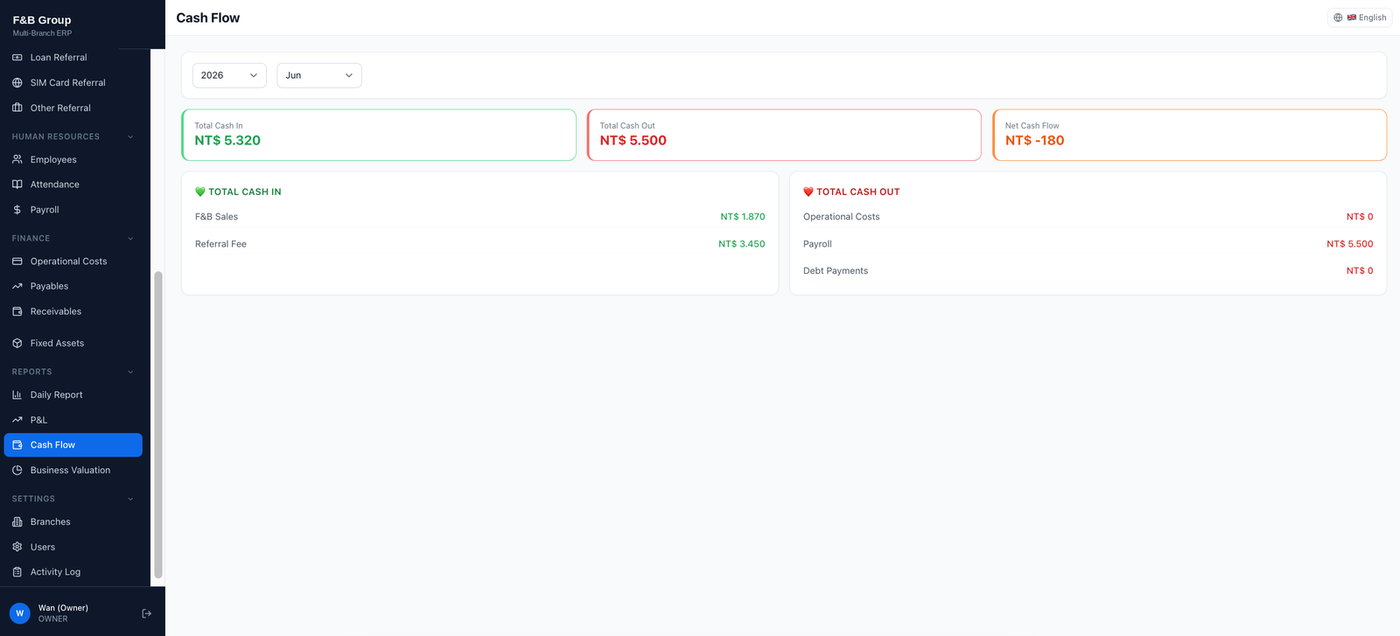
Multi-Branch ERP for an F&B Business
One system for POS, inventory, finance, HR and cross-branch reporting.
The situation: Several restaurant branches and four side businesses, each with its own bookkeeping, and no owner-level view across any of them.
What changed: Branch data kept separate, but visible combined to the owner for the first time, replacing four separate spreadsheets and a lot of guesswork.
Read the full case study →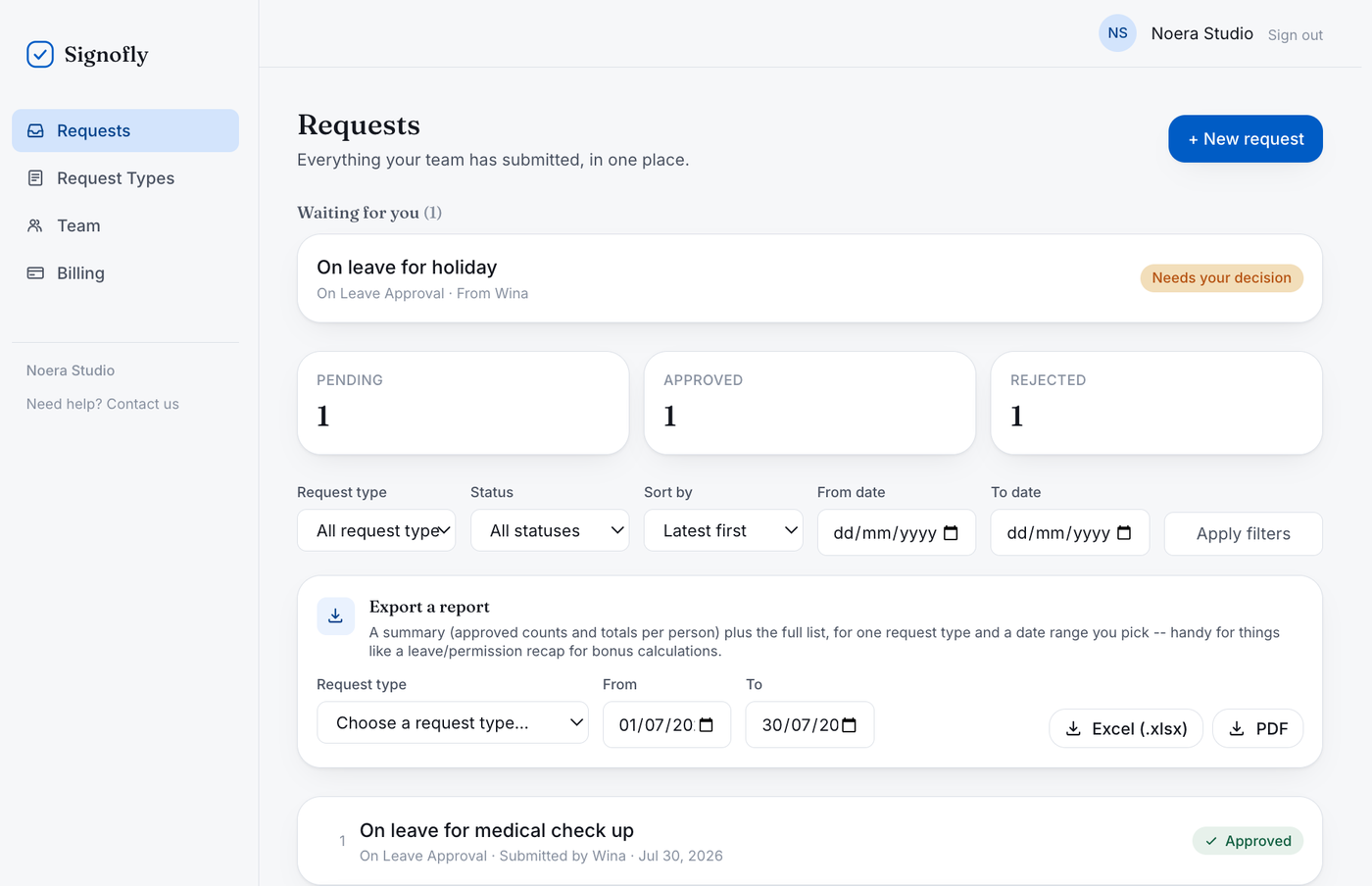
Noera product · Live, first teams onboarding
Signofly: Approval Tracking for Small Teams
Custom request types, automatic notifications and a full audit timeline.
The problem it solves: Approval requests scattered across chat threads and individual inboxes, with no record of who approved what, or when.
What it does: Gives small teams one shared place for requests, so every request has a status, an owner and a timeline.
Read the full case study →Real systems, delivered and live, not concepts waiting for a client.
Multi-branch ERP · Approval tracking · Workflow automation
Initial 30-minute discovery call · Remote-first · Direct access
Frequently Asked
Common questions before you reach out.
What size of business is this actually for?
Noera works best for small and medium-sized businesses that have outgrown spreadsheets, shared inboxes and group chats as their main way of tracking work, and want a system built around how they actually operate rather than an off-the-shelf product.
What happens on the initial discovery call?
It's a short 30-minute conversation to understand your current workflow, the problem you're facing, and whether Noera is a suitable fit. Detailed solution design and consulting are handled separately when needed. If it looks like a fit, you'll get a short follow-up email afterward.
Do you build from scratch, or use templates?
Custom, shaped around your actual workflow. There's no fixed menu of packages to choose from. The scope is defined after we understand what your business needs, not before.
How much does a project cost?
It depends on scope, which is exactly why we don't quote a price before understanding the problem. After the discovery call, if it looks like a fit, next steps and terms get worked out directly with you.
Do you work with businesses across different countries and time zones?
Yes. Working across time zones and countries is standard practice, not an exception. We work async by default, with written updates carrying most of the communication, so a different time zone isn't a blocker.
Is this the same as hiring a freelance developer?
No. A developer builds what they're told to build. Noera works as a business systems partner, helping figure out what actually needs to be built before any development starts, and staying involved through launch and support.
Get In Touch
Not sure exactly what needs to change? That's a normal place to start.
You don't need a finished specification, a list of features, or even certainty about what the fix looks like. Tell us what's currently slow, manual, or dependent on one person, and we'll start from there.
It starts with an initial 30-minute discovery call. We typically reply within one business day, and work with clients internationally as a matter of course.
Discuss your workflow: